sevice@vcarsystem

*Name

*Mobile

+86

*E-Mail

*Company

*Support types

*Country

*Province/City

*District

Leave Message

I agree with the PrivacyPolicy and terms and conditions of VCARSYSTEM

ADVANTAGES

Maximize Flexibility with Modular Design

Adapts to dynamic testing needs and scales from small setups to full HIL systems without hardware waste.

All-in-One Integration for Higher Efficiency

Unifies bus, signal, HIL, and fault injection in one platform—reducing setup time, improve efficiency.

High-Speed Long-Duration Logging

Supports continuous high-load acquisition (e.g., CAN FD + automotive Ethernet) for 72+ hours, far exceeding SD-based solutions.

Agile Deployment & Lower Investment

Compact design eliminates need for dedicated labs. Modular expansion avoids upfront overinvestment.

Open Ecosystem & Workflow Integration

Python automation, open SDK, and standard formats enable seamless integration without workflow disruption.

Stable Performance & Industry Compatibility

Reliable under high-load, multi-user scenarios. Fully compatible with mainstream 3rd paryt tools.

FUNCTIONS

Modular Channels & Board-Level Expansion

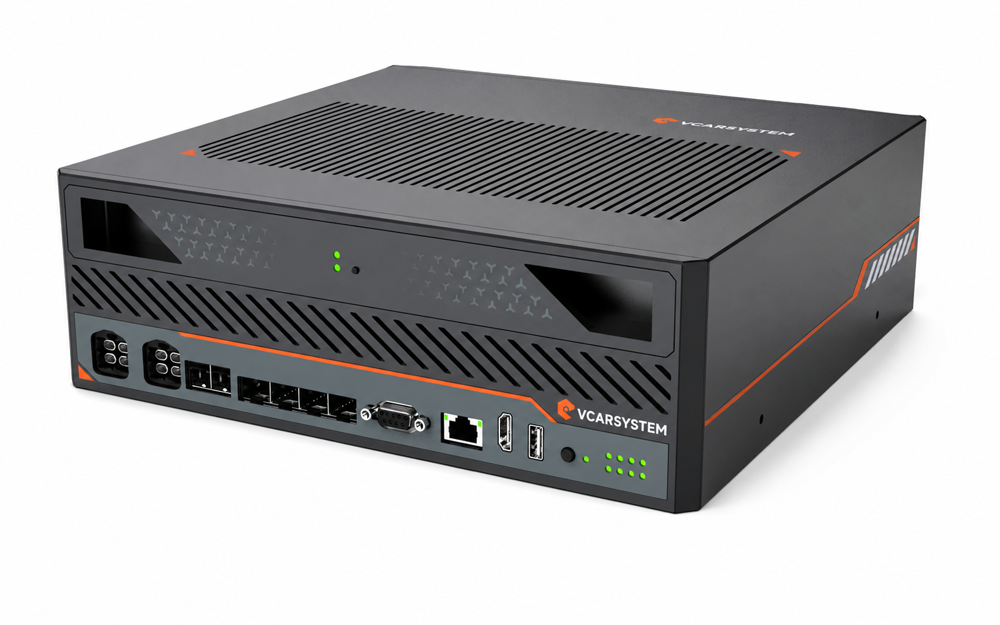
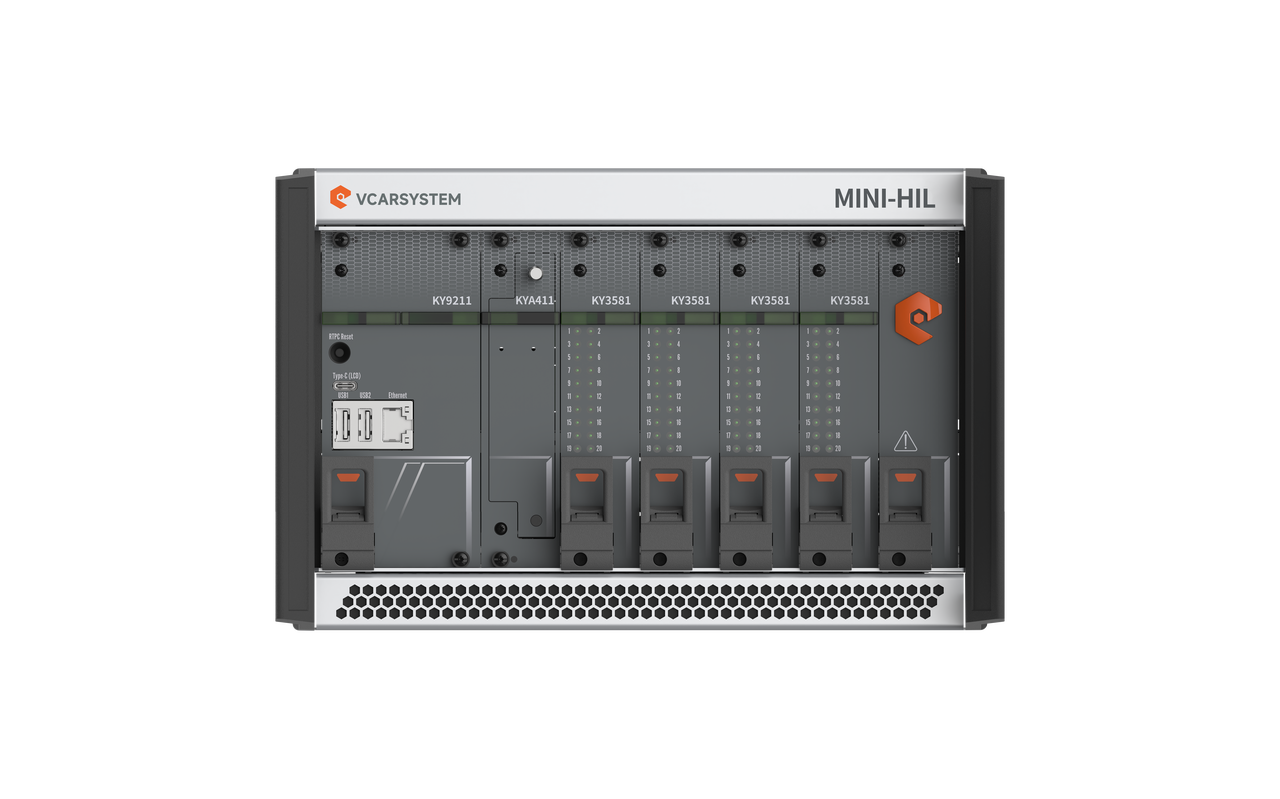
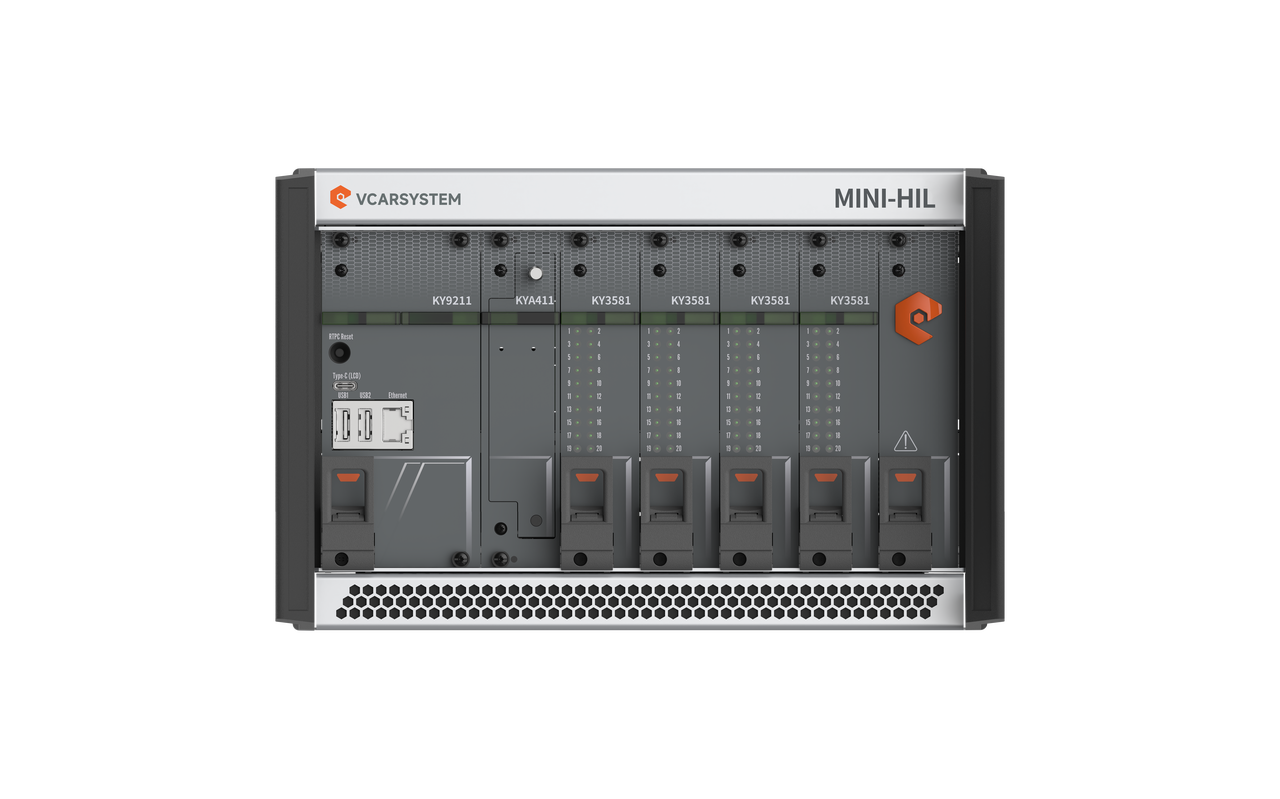
Supports multiple interchangeable multifunction base cards. The modular board architecture, combining base cards with various functional daughter cards, enables flexible channel-level configuration and switching. The system can provide up to 80 bus communication channels or more than 120 conventional I/O channels, while external 2.5G high-speed Ethernet ports allow further Ethernet interface expansion. It precisely meets a wide range of requirements, from bench testing to system-level HIL simulation.

Broad Compatibility for Buses & Signals

Supports CAN/CAN FD (up to 8 Mbit/s), LIN (≤19.2 kbps, protocol 1.3–2.2), and dual-channel FlexRay, while extending to automotive Ethernet T1 (100/1000 Mbps) and sensor protocols such as SENT, SPC, and PSI5. It integrates bus communication with general-purpose signals—including 0–60V analog input, ±100 mA digital output, and resistance simulation—as well as dedicated sensor signals, enabling true “bus + sensor/actuator + ECU + HIL” synchronized testing in a single platform.

High-Performance HIL Computing & Parallel Testing

Powered by 12th Gen Intel® Core™ processors, the platform delivers high-performance computing capability to meet the development and validation requirements of Rapid Control Prototyping (RCP) and Hardware-in-the-Loop (HIL) testing. It supports parallel multitasking, hybrid bus communication, and functional testing, while the 6-core processor ensures reliable low-latency operation under concurrent workloads, making it ideal for multi-user parallel testing and complex system-level validation scenarios.

Compact Deployment & Flexible Offline Operation

With a compact chassis (455 × 330 × 144 mm), MINI HIL can be deployed on desktops, lab benches, or directly in vehicles without dedicated infrastructure. It operates independently without a PC and supports a wide 9–36V DC input (28V typical), making it ideal for remote testing, long-duration durability validation, and field deployment where network access is limited or unavailable.

High-Speed & Reliable Data Logging

Optional dual hot-swappable U.2 SSDs (1TB–8TB each), delivering up to 2.8 GB/s read/write performance and total storage up to 16TB. It supports industry-standard formats including DAT, MDF, MF4, ASC, and BLF, ensuring direct compatibility with 3rd party tools. A 1 μs timestamp resolution guarantees precise synchronization across all bus, signal, and HIL data.

Node Simulation, Fault Injection & Full Lifecycle Validation

The platform supports simulation of master/slave nodes across CAN/CAN FD, LIN, FlexRay, and automotive Ethernet, with configurable baud rates, sampling points, and termination resistors. Built-in fault injection capabilities—including node disconnection, termination faults, and signal interference—along with OBD diagnostic testing, enable comprehensive validation of system robustness and compliance across the entire development lifecycle.

Open Automation Ecosystem & Seamless Software Integration

MINI HIL provides native support for Python scripting and a real-time SDK, enabling integration with custom automation and test management systems. In combination with VCAR DAS, it delivers unified configuration, real-time visualization, signal parsing, HIL scheduling, and automated execution. Support for OTA updates and open interfaces ensures long-term scalability and seamless integration with existing development and calibration toolchains.

SOLUTIONS

E-Mobility

1/2

Chassis Safety

2/2

E-Mobility

VCARSYSTEM has consistently pursued excellence and innovation in automotive powertrain system R&D and validation through close collaboration with industry leaders. Focusing on core domains including engine management, transmission control, battery management, and motor control, VCARSYSTEM delivers end-to-end testing and validation solutions, ensuring superior product performance and an exceptional user experience.

Learn more

Related products

HIL SYSTEM

More

VCAR DAS

More

VCAR EA

More

Chassis Safety

Today, automotive chassis systems are becoming increasingly intelligent, with growing complexity in their system communication and functions. In response to this trend, VCARSYSTEM has launched a series of solutions covering steering, braking, suspension, and more, helping engineers conduct various tests and verifications on complex chassis control systems within limited resources.

Learn more

Related products

HIL SYSTEM

More

VCAR EA

More

E-Mobility

E-Mobility

VCARSYSTEM has consistently pursued excellence and innovation in automotive powertrain system R&D and validation through close collaboration with industry leaders. Focusing on core domains including engine management, transmission control, battery management, and motor control, VCARSYSTEM delivers end-to-end testing and validation solutions, ensuring superior product performance and an exceptional user experience.

Learn more

Related products

HIL SYSTEM

More

VCAR DAS

More

VCAR EA

More

Chassis Safety

Chassis Safety

Today, automotive chassis systems are becoming increasingly intelligent, with growing complexity in their system communication and functions. In response to this trend, VCARSYSTEM has launched a series of solutions covering steering, braking, suspension, and more, helping engineers conduct various tests and verifications on complex chassis control systems within limited resources.

Learn more

Related products

HIL SYSTEM

More

VCAR EA

More

APPLICATION SCENARIOS

Automotive ECU Validation & HIL Simulation

Full lifecycle validation—from concept to compliance—supporting agile SDV development.
01

In-Vehicle Network & Diagnostics

CAN/LIN/Ethernet validation, signal integrity testing, and OBD fault diagnostics.
02

Automotive E/E System Validation

Domain controllers, ADAS, and complex network validation, including cross-domain interaction.
03

Industrial Automation & IoT

Validation of industrial communication systems in manufacturing, energy, and smart factories.
04

Component & Product Testing

End-of-line validation for ECUs and communication modules, ensuring quality and reliability.
05

R&D & Field Troubleshooting

Portable deployment for on-site diagnostics, intermittent issue logging, and prototype validation.
06

Education & Research

Scalable platform for teaching and research—from basic communication to advanced HIL systems.
07

Download Center

SOFTWARE

Download

VIDEOS

Download

USE CASES

Download

GET SUPPORT

Contact us

To address the growing complexity of R&D requirements, we will tailor solutions to your specifications and offer expert consulting and engineering services.

Contact us