Intelligent Thermal Management Calibration Transformation for a Leading Automotive OEM
From 30-Day Test Cycles to Sub-Week Validation
A leading automotive OEM implemented an automated thermal management calibration and test platform developed by VCARSYSTEM. The solution combines test orchestration, real-time simulation, automated parameter optimization, data acquisition, and reporting in one integrated workflow.
As a result, the customer increased test capacity by 5–10×, enabled 24/7 unattended operation, and moved key validation activities about three weeks earlier in the vehicle development cycle.
High-Complexity Thermal Validation at Scale
With the rapid growth of new energy vehicles, thermal management has become a critical system affecting battery safety, driving range, energy efficiency, and cabin comfort.
The customer’s thermal management team is responsible for calibration and validation across multiple vehicle platforms. With only 3–4 core engineers, the team manages around 30–40 calibration programs per year.
Their work covers:
Cooling and heating performance
Defrosting and defogging
Cabin comfort optimization
Energy management strategies
Component and system durability
Calibration parameter tuning
Each vehicle program has different control logic and test requirements, making standardization difficult.
To address the limits of manual testing, the customer conducted a six-month evaluation of multiple suppliers. VCARSYSTEM was selected to build a fully automated calibration platform.
Limitations of the Previous Manual Process
Test Capacity Bottlenecks
A single calibration cycle could take up to 30 days, creating a backlog when multiple programs ran in parallel.
Manual operation led to inconsistent test conditions and limited result comparability.
Most programs could only complete one main validation loop due to long cycle times.
Highly Customized Workflows
Each program required different logic, which was difficult to support with standard test systems.
Problems were often found late in development, leaving little time for correction and re-testing.
End-to-End Automated Calibration Platform
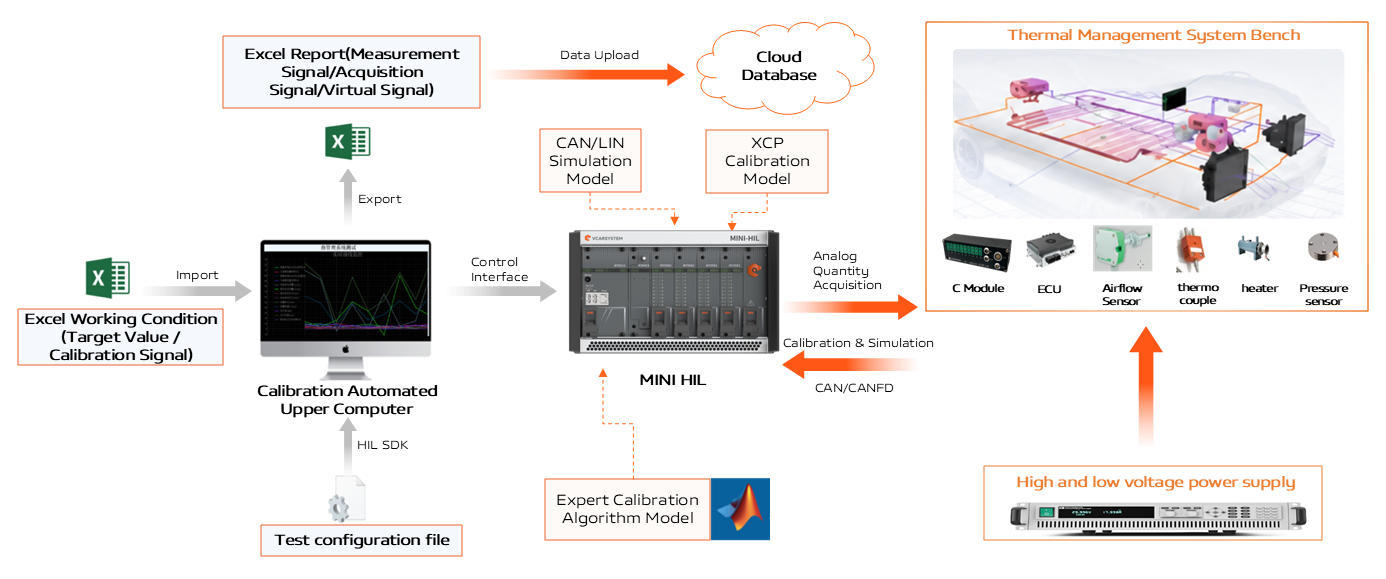
VCARSYSTEM developed a fully integrated system covering the entire workflow:
Test setup → Automated execution → Data collection → Parameter optimization → Evaluation → Reporting
The solution is built on VCARSYSTEM’s own technology stack, including real-time OS, communication protocols, and automation tools. This allowed deep integration with the customer’s existing processes without changing their workflow.
Three-Layer System Architecture
The platform combines host software, MINI HIL real-time system, and existing physical test benches.
1. Calibration Control Software
The host software is the main control interface for all test activities.
Key functions:
Visual test setup and one-click import
Fully automated test execution
Real-time monitoring and visualization
Automatic report generation
Structured data storage and traceability
Multi-bench management
Cloud data synchronization
It standardizes workflows while keeping flexibility for different vehicle programs.
2. Real-Time Execution and Optimization Engine
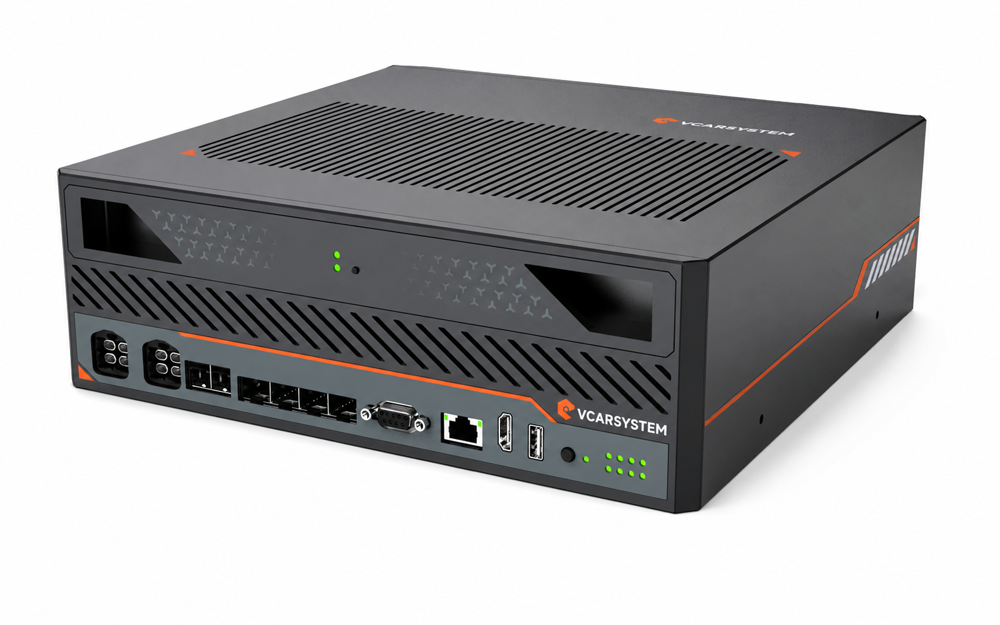
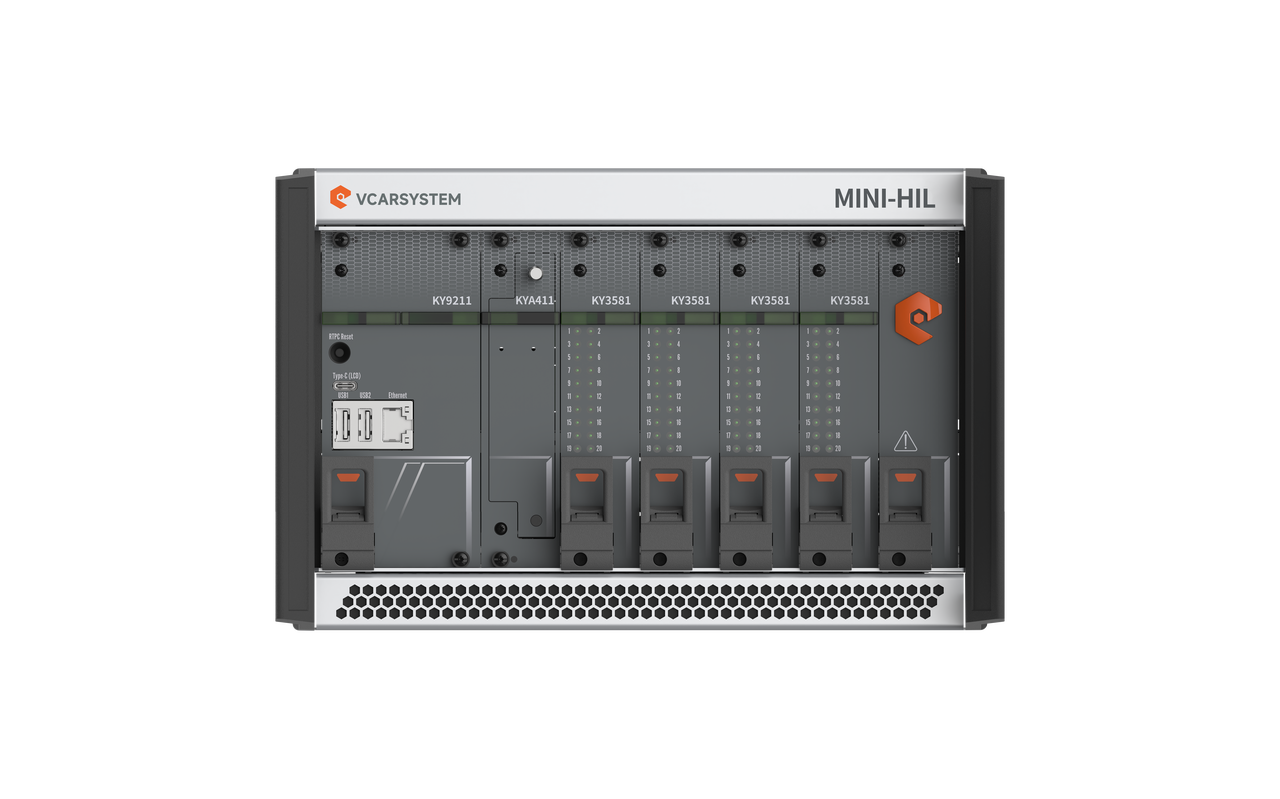
The MINI HIL system provides real-time control, simulation, and optimization.
Key functions:
RT-Linux real-time operating system
1 ms deterministic scheduling
CAN and LIN network simulation
XCP/CCP calibration support
Multi-parameter optimization
GT-POWER integration
Hardware-in-the-loop and simulation hybrid testing
The optimization engine automatically evaluates parameter combinations, reducing manual trial-and-error work.
3. Physical Test Bench Integration
The system connects directly to existing thermal test benches and equipment.
Supported signals include:
This enables fully unattended 24/7 operation and higher test bench utilization.
Why VCARSYSTEM Was Selected
Full Technology Stack Ownership
VCARSYSTEM controls the full stack, including real-time OS, communication protocols, and software tools. This enables deep customization and reduces dependency on third-party vendors.
Experience with Custom Test Systems
Thermal calibration requirements vary widely between vehicle programs. VCARSYSTEM has experience translating complex requirements into scalable system designs.
On-Site Engineering Support
Engineers worked directly on-site with the customer during key phases, including design, development, integration, and commissioning.
Long-Term Platform Support
The modular system can be expanded for new vehicle platforms and future testing needs without replacing the existing system.
Customer Statement
“Our thermal management testing involves complex logic and high customization. Many suppliers could not meet the requirements. VCARSYSTEM took on the challenge. Their engineers worked on-site with our team throughout the project. The collaboration was professional and closely coordinated, and the system is stable and reliable.”
Measurable Results
Earlier Validation Start
Thermal calibration now starts about 3 weeks earlier, allowing earlier issue detection and correction.
5–10× Higher Test Capacity
Test cycles were reduced from ~30 days to under 7 days, enabling more parallel projects without adding staff.
More Iteration Cycles
Each program can now run 3–4 full validation loops instead of just one.
Standardized Data
All test data is stored in a unified format, improving traceability, comparison, and root-cause analysis.
Higher Equipment Utilization
24/7 unattended operation significantly increases test bench usage and reduces manual workload.
Scalable Engineering Foundation
Reusable Workflows
Calibration processes can be reused across different vehicle platforms, supporting standardization.
Structured Data for Analysis
Accumulated test data supports benchmarking, optimization, anomaly detection, and future AI applications.
Modular Expansion
The system can be extended with new interfaces, models, and test functions without replacement.
Shift in Engineering Work
Before automation, engineers spent most time on manual testing and data processing.
Now they focus on higher-value work:
This shifts engineers from operators to system-level experts.
Application Coverage
Performance Calibration
Automated tuning of cooling, heating, defrosting, and cabin comfort functions.
Functional Testing
Batch execution of test cases with automatic reporting.
Durability Testing
24/7 long-duration system testing.
Simulation-Based Testing
Integration with GT-POWER for hybrid virtual-physical testing.
Data Management
Centralized storage and analysis of calibration data.
Multi-Bench Control
Centralized scheduling and monitoring of multiple test benches.
At a Glance
Customer
A leading automotive OEM with multiple new energy vehicle platforms
Challenge
30–40 calibration programs per year with a 3–4 engineer team
Solution
An integrated automated calibration platform combining software, real-time system, and existing test benches
Key Results
Test cycle reduced from ~30 days to<7 days
5–10× increase in test capacity
3–4 validation iterations per program
~3 weeks earlier validation start
24/7 unattended operation
Fully standardized and traceable data