Paradigm shift in ADAS protection: Scalable PCIe architectures to control massive data streams
Introduction
The evolution of advanced driver assistance systems (ADAS) is taking place at a rapid pace. While Level 2 systems have already established themselves on the market across the board, the focus of current development has been on Level 2++ and highly automated driving functions according to Level 3 and beyond for some time. These advances require a significant increase in the complexity of sensor technology: A network of radar, video, lidar and ultrasonic sensors forms the basis for a complete perception of the environment.
To orchestrate these complex sensor networks, high-performance control units (ECUs) are essential. These have to process massive data streams within milliseconds in order to derive precise driving strategies without latency.
In order to increase efficiency in the development of complex control strategies, a massive shift of software functions to the laboratory environment is taking place. Wherever possible, virtualization replaces physical hardware with simulations and experiments. However, this approach requires that the models used are continuously validated and validated by real environmental data. This results in an urgent need for flexible tools that ensure both efficient data collection and seamless data access via cloud or backend infrastructure.
A modern development environment must also be able to be seamlessly integrated into the processes between OEMs and suppliers based on the division of labor. The entire life cycle of the vehicle must be covered – from early prototyping and the various maturity levels of series development to functional enhancements and fleet management after the "Start of Production" (SOP).
Regardless of the project phase, engineers need solutions for the acquisition and analysis of measurement data. The requirements for these systems vary extremely: The bandwidth of the data configurations ranges from a few megabytes to several gigabytes per second in the high-end range of sensor fusion.
Vcarsystem addresses these challenges with a modular and scalable end-to-end portfolio. The solutions are optimized to efficiently support both in-vehicle data acquisition (DAQ) and test and validation tools across all phases of the V-Model (see Figure 1).
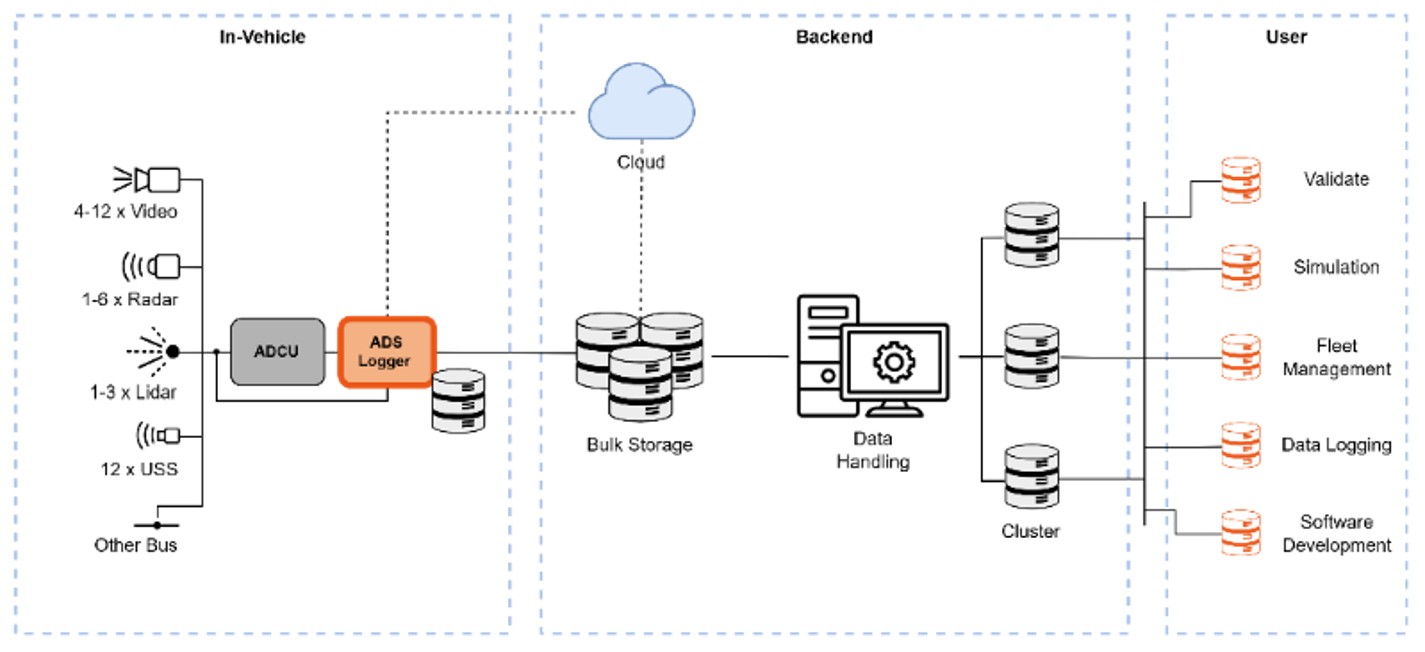
Figure 1: The process chain from raw data acquisition to the provision of system-relevant information.
Challenges of conventional on-board measurement technology in ADAS validation
As soon as prototype hardware (ECU) and the corresponding sensor technology are available to function developers, classic in-vehicle measurement technology is used. However, with the achievement of autonomy levels 2++ and higher, the number of sensors to be integrated increases exponentially, pushing conventional measurement architectures to their limits.
Modern ADAS architectures already integrate up to twelve cameras with resolutions between three and eight megapixels. This setup is complemented by a composite system of six (or more) radar sensors of the latest generation (e.g. imaging radar) as well as lidar and ultrasonic sensors. At the same time, data streams from the classic domains – such as powertrain, chassis, infotainment and connectivity – must be recorded synchronously. For validation, high-precision reference data from ground truth sensors and external reference measurement systems is also mandatory.
The simultaneous acquisition of these heterogeneous data sources requires a comprehensive set of measurement technology that poses critical challenges for the vehicle interior:
· Installation space and energy requirements: The required measuring components take up considerable space in the vehicle interior and represent a high electrical load for the on-board electrical system.
· Interoperability and redundancy: Since measurement solu tions from different manufacturers are often not fully compatible, data loggers often have to be implemented redundantly. This further increases the complexity and system weight.
· Bandwidth management: The enormous data rates generated by high-resolution sensor technology must be recorded absolutely losslessly. This places the highest demands on the write speeds and thermal stability of the storage media.
Due to the high networking density, modern measurement solution setups are highly complex (see Figure 2). In the event of system errors or signal failures, identifying the source of the error is extremely time-consuming. In such heterogeneous environments, efficient troubleshooting is only possible by tying up personnel and spending a lot of time, which unnecessarily prolongs the validation cycles in real road tests.
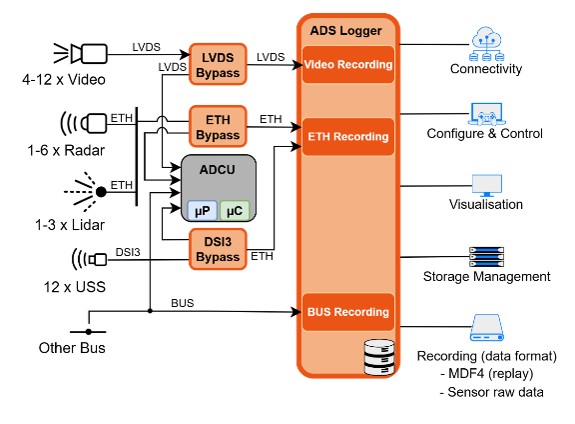
Figure 2: Vcarsystem Traditional Data Measurement Setup
The shift to PCIe-based measurement architectures
With the next generation of ECUs, automotive manufacturers are consistently pursuing the strategy of bundling the process intelligence of formerly "smart" sensors centrally in high-performance Automated Driving Control Units (ADCUs). This architectural change requires a fundamental realignment of measurement technology. Modern solutions rely on the PCIe interface (Peripheral Component Interconnect Express), which enables data throughputs in the multi-gigabyte range and at the same time significantly minimizes the hardware footprint in the vehicle (see Figure 3).
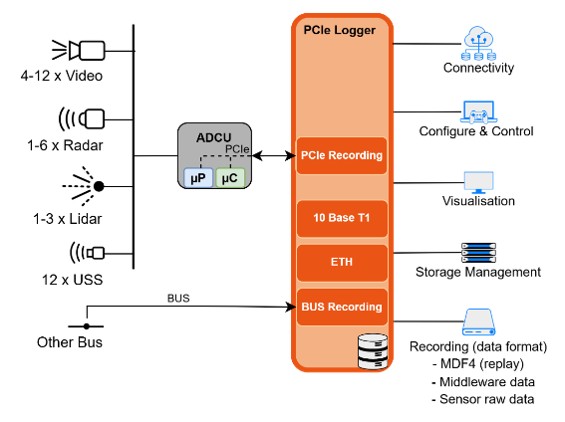
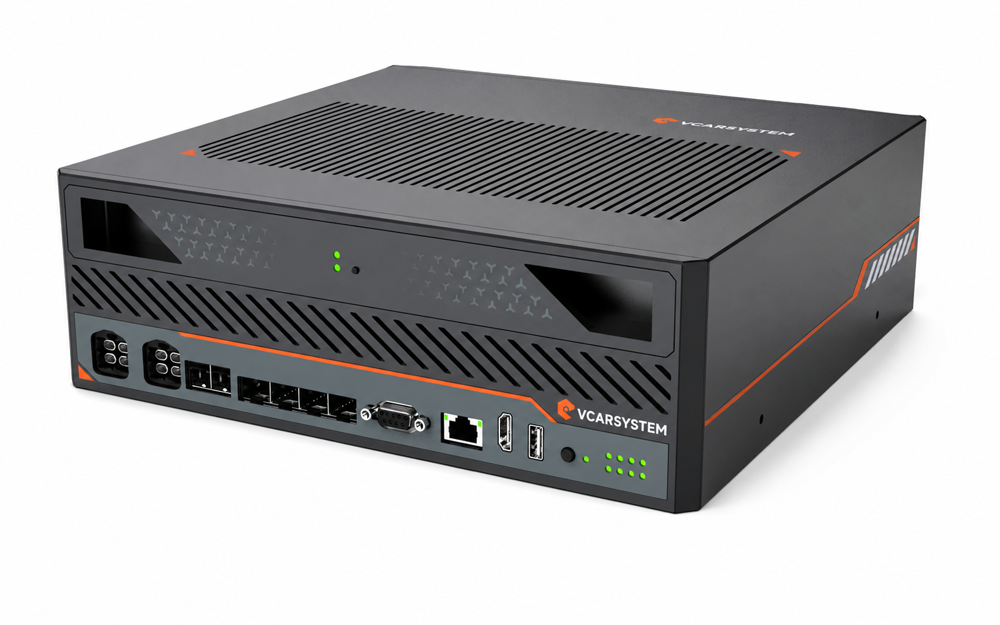
Figure 3: Vcarsystem PCIe Logger
The integration of the PCIe interface directly into the ECU hardware forms the foundation of a modular measurement philosophy. This architecture allows raw data from both microcontrollers (μC) and high-performance microprocessors (μP/SoC) with a cumulative bandwidth of up to 16 GB/s to be transferred to the measurement network.
The decisive technological advantage lies in the type of data extraction: By using Remote Direct Memory Access (RDMA) or Direct Memory Access (DMA), data transfer via the PCIe bus takes place efficiently and with minimal CPU load. All sensor data – from high-resolution video streams to complex radar and lidar point clouds – can be consolidated via a corresponding middleware and stored without loss. At the heart of this infrastructure is the scalability of the Vcarsystem PCIe logger (see Figure 4), which can be flexibly adapted to the respective requirements of the vehicle architecture.
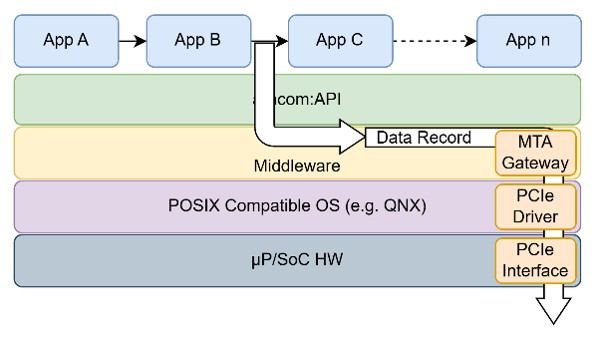
Figure 4: PCIe integration into middleware (example based on μP/SoC)
The ecosystem is completed by the in-vehicle development environment ADsoft developed by Vcarsystem. This software suite is natively tuned to the PCIe logger and provides specialized support for the development and validation of core ADAS functions. These include, among others:
· Longitudinal and lateral control: Adaptive Cruise Control (ACC) and Lane Departure Warning/Lane Keep Assist (LDW/LKA).
· Safety-critical systems: Automated Emergency Brake (AEB).
· Automated Parking Functions: Automated Valet Parking (AVP).
Through the deep integration of hardware and software, adSoft significantly shortens the iteration cycles in function development and ensures that the enormous amounts of data from the PCIe infrastructure are immediately usable for optimization processes.
From real driving tests to the laboratory environment
In view of the enormous pressure to innovate and the demand for ever shorter time-to-market cycles, the importance of hardware-in-the-loop (HiL) systems plays a key role in vehicle development. These systems make it possible to reproduce both real data recorded in the field and synthetically generated scenarios in a controlled manner. Complex driving situations can be simulated either in real time or – to speed up validation processes – in time-lapse.
Vcarsystem addresses these requirements with a specialized hardware open-loop (HOL) solution, among other things. In contrast to the classic closed-loop approach, the focus here is on the precise replay of sensor data:
· Sensor emulation: The vehicle's own sensor technology is replaced by high-precision emulators.
· Data feed: Data sets previously obtained in real road tests are fed directly into the ADCU via the native interfaces.
· Function optimization: This methodology allows developers to optimize software functions of the ADCU under reproducible conditions or to validate new software versions (builds) directly against known reference scenarios.
This closed loop of on-road data collection and precise re-simulation in the lab minimizes the need for physical test drives and significantly increases the maturity of the software before it is tested again in the real vehicle (see Figure 5).
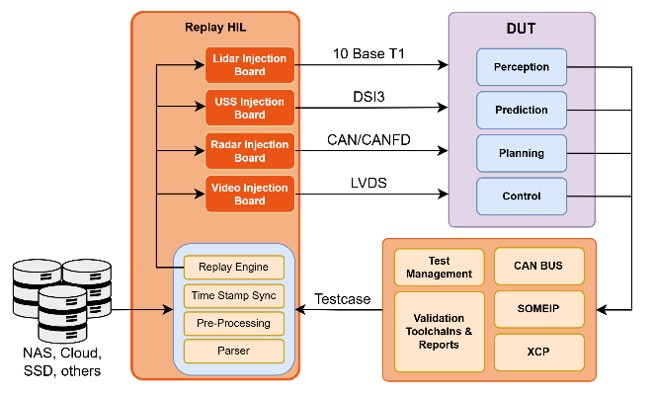
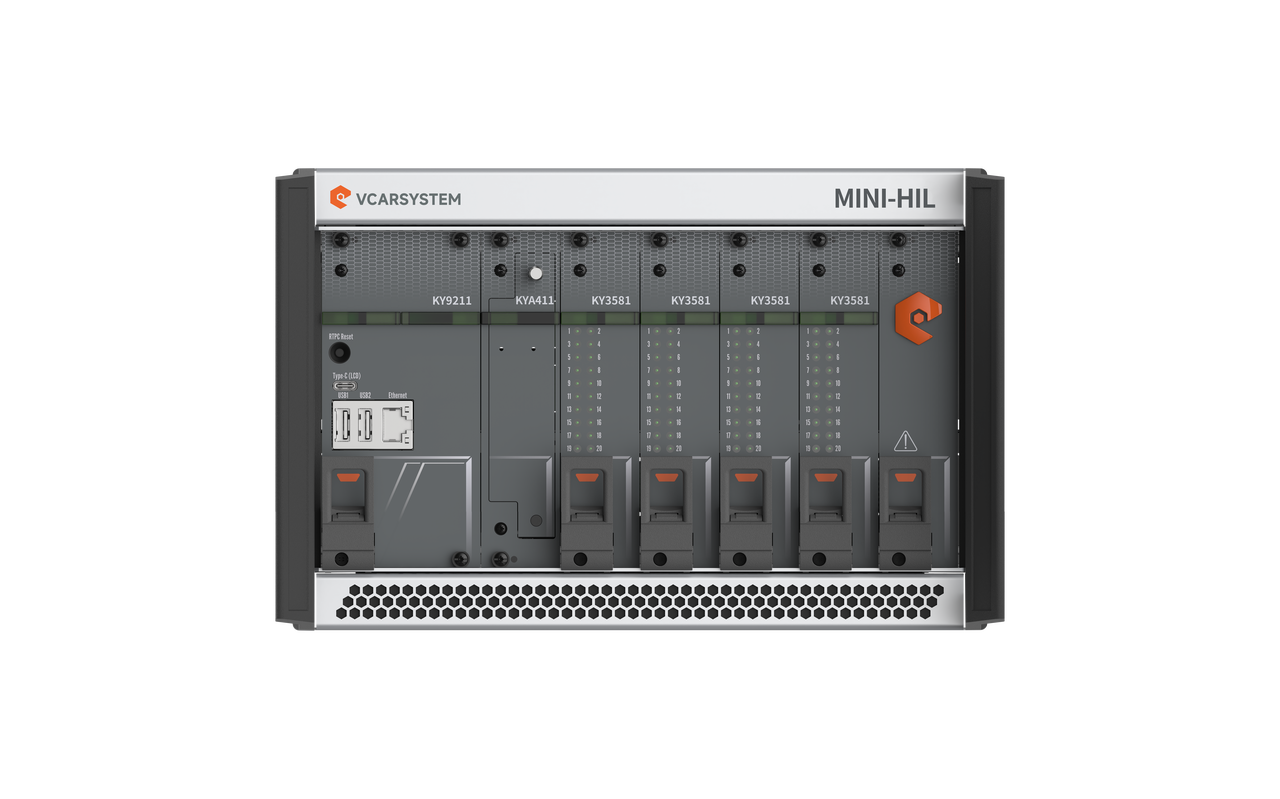
Figure 5: Vcarsystem Replay HOL
Such validation solutions are no longer a niche product but have established themselves as an integral part of the automotive development process. They form the backbone of modern validation strategies and are essential for making the complexity of highly automated driving functions manageable and at the same time sustainably reducing development costs.
Synergies through PCIe architectures
Parallel to the evolution of in-vehicle measurement technology, a fundamental change is taking place in validation. The technological driver for the use of PCIe-based replay hardware open-loop (HOL) systems is the drastic reduction of system complexity. A decisive advantage: Since the PCIe interfaces are designed for bidirectional data transport, existing PCIe loggers can be used as replay units without hardware conversion. This dual function leads to massive optimization of capital expenditure (CAPEX) and more efficient hardware utilization.
The PCIe Replay solution offers tailor-made approaches for different development disciplines that are hardly feasible with conventional methods:
· Function development: Software developers often need to look at their algorithms in isolation. The solution makes it possible to feed data streams directly into the middleware in a targeted manner (see Figure 6). This allows precise validation of how the algorithm reacts to specific input data and which results are output immediately without unnecessarily burdening the overall system.
· System development: In contrast, the focus of system developers is on the interaction between the various software stacks and the hardware. Here, PCIe replay enables the injection of comprehensive data streams at the system level to check the stability and performance of the entire ADCU under realistic load conditions.
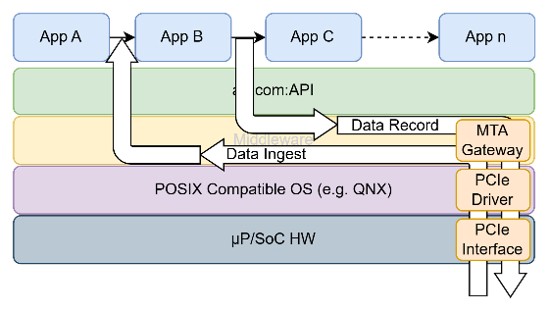
Figure 6: PCIe Data Collection via Middleware (Example)
The Vcarsystem PCIe Replay HOL can be used to implement highly specific requirements that reach technological limits with traditional replay approaches. The combination of high bandwidth, low latency and flexibility in data ingestion achieves a level of validation that is essential for securing next-generation highly automated driving functions.
Leap in efficiency in ADAS validation through technological convergence
Vcarsystem's DAQ solutions mark a turning point in the acquisition and processing of measurement data for ADAS development. In view of the exponentially increasing demands on data volume and quality, the scalable approach presented here offers the necessary technological answer to make feature developments not only more precise, but above all more efficient.
The high-performance PCIe technology replaces a large number of heterogeneous individual systems and proprietary software stacks. This not only reduces the installation space volume and the electrical load in the vehicle, but also minimizes the susceptibility to errors in complex measurement chains. Thanks to the bidirectional interfaces and the multiple use of the hardware (logging and replay), development times can be shortened and investment costs (CAPEX) can be significantly optimized. The seamless availability of high-quality data across the entire V-cycle – from the laboratory to the prototype to the production fleet – creates a consistent basis for validation.
This holistic approach offers function developers the necessary leeway to validate highly complex automated driving systems. This paves the way for a future in which computer-aided sensor systems not only complement human sensory perception, but consistently surpass it in terms of safety and reliability.